Counterspell mk1 Build Blog
- Aug 15
- 4 min read

After building a plastic antweight in the fall, I wanted to move up a notch to building a 3lbs beetle robot. This would allow me to gain more experience with machining and better design practices, as the loads experienced are much higher than in a plastic class. So over winter break I began CADing Counterspell, laying out components, structure, and the grappler system.

The first iteration was very unoptimized but was a good start. I designed to use a combination of TPU (blue), UHMWPE (black), G10 composite (dark gray), and AR500 steel (silver) as the main structural material choices. Additionally aluminum standoffs run vertically in the chassis to mate the components and screw on the g10 top and bottom plates.
The main TPU body is split into 7 major pieces for ease of manufacturing and repairability. The 2 main chassis the house the electronics and drive system, a back wall that extends behind and around the UHMW uprights of the weapon stack, 2 front wall pieces that mount for the outer and front forks, and then the 2 outer wrangling forks. I originally used a sandwich or steel and UHMW for the lifter as this gives me an impact-resistant base with a very hard and durable end.
The flaws of this iteration were simply how unoptimized it was for weight. The wires of the motors ran under themselves, adding unnecessary height. The battery and electronics layout took up far more space than needed, adding unnecessary depth. Then the sandwiched lifter added far too much weight, especially because the inner 2 steel pieces were seeing as much of the shock from weapons.
With this I changed the electronics layout
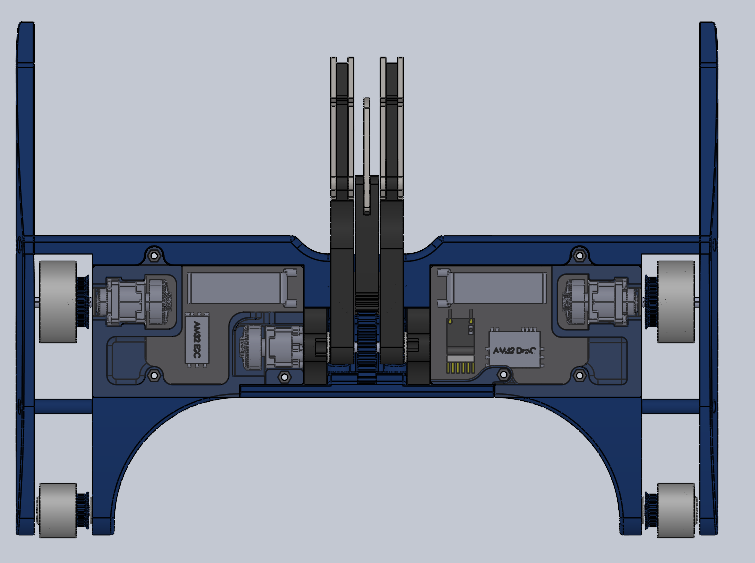
Optimized the shape of the uprights

Changed the lifter setup, added a hoofed inner fork to absorb impacts, and lengthened the outerforks to get more control

Additionally I designed alternate configurations for the front forks, including these AR500 slim ones

This version went on to compete at a local competition run by UPitt at Johnstown. Issues with the gearing of the lifter meant it didn't function at the level I wanted to, but somehow the resilience of the chassis made up for it. Out of 21 opponents, I ranked 7th with a 3-2 record.
I now had two weeks to improve before the May NHRL event in Norwalk. This would be a much larger and more competitive event with a full production crew.
Most of the changes were for the grappler stack. I ditched the hybrid UHMW-Steel lifters and used only steel. This let me bring the uprights closer together and saved a lot of weight. I added a bearing on the other end of the lifter motor shaft so it isn't cantilevered. Then I added a custom aluminum pinion to replace the nylon one that kept stripping. Leading to this version with a professional shot from NHRL.

Due to some issues with the grabber not being consistent, I switched over to using on underlifter config for the event. For a first NHRL I'm happy with how I performed, going 2-2 and qualifying for the round of 32 in the 104 bot event.
Here is my match against Bad Luck V
After NHRL, the semester ended, but I kept making small improvements to the bot in preparation for a local event, Hive Hysteria, in southern Maryland. The chassis remained unchanged as it proved nearly indestructible at NHRL, but the grabber needed some work.
The issues at NHRL were caused by the flexibility in the TPU gear in the grabber. After a few grabs, the teeth relax and became unable to lift load. As I didn't have access to a full machine shop due to the timing of my internship and summer hours for UMD's shop, I decided to improvise. I changed the gear to a stacked system, with 2 Nylon gears that were rigid to lift, then a TPU one in between that would be there to hold the torque to self-right if the nylon ones snapped.

This improvement led to this fun clip of me just straight launching my ~100g TPU baleen wedges 10ft into a wall
So with that, I went to Hive with the improvised upgrade. This event was set up quite uniquely. You start with 3 tokens and can fight whoever you want and as many times as you want. You then bet your tokens, and the 4 robots with the most tokens made playoffs. This was both very fun, but also wonked up the rankings quite a bit as in the last 20 minutes before playoffs everyone started betting 3 tokens on matches to slingshot into playoffs.
I ended up going 2-2, my losses being to the world champion and the same hammer saw bot that beat me at NHRL. So not including the crazy last 20 minutes, I tied for 10th place out of 24 bots.
Here was one of my better fights of the day against Snuggle Muffin, a lifter vert archetype that was currently the number 1 seed
The last match was quite crazy though as fighting the world champion for 3 tokens gets quite intense. According to some of the more experienced members, I nearly beat him as I dominated the control category. Unfortunately he got a lucky shot on my hoof and ripped it straight through the front wall.
And well here we are, the end of a year-long era for me. This was (hopefully) my last competition running a grappler-lifter archetype. I said this in Jeff's post but I'll reiterate why I'm choosing to switch archetypes. Although Counterspell performed quite well at all of it's competitions, and I do see some slight improvements I could make, I've basically reached the ceiling of a grapplers potential. In every competition the indestructible chassis design, with a very wide and controlling body, did far more work to win fights than the lifter did. This is mostly just because of the lack of damage I can apply, which believe it or not is quite critical for combat robots.
Because of this, Counterspell mk2 is going to be a hammer-saw archetype with a very similar chassis to the grappler. This allows to me couple the controlling body with an overheard damaging saw that I think will be a very competitive balance.
So with that, thanks for reading through all of this and see you next semester.
