Motorized Wrench
- Oct 18, 2025
- 3 min read
Through my enrollment in Project Lead the Way - Engineering, I had a class called Engineering Design and Development. In this, students go through a full product development cycle from conceptualization to working prototype. As part of this, we had monthly design presentations, design reviews with engineering professionals, and a final presentation to representatives from major engineering companies and Carroll County dignitaries. For this project, I partnered with Molly Mikalauskas and Owen Figuli to make the Grease Monkey team.

We started by determining team responsibilities. My primary responsibilities were CAD, prototype planning and development, manufacturing the parts (mostly 3DP), preparing the presentation PowerPoints, and communicating with experts who would be advising us.
Through prior experience, we know that using hand tools is often unsafe or can cause strain if used incorrectly or for too long. Through extensive research we defined this problem as:
In 2023, there were 400,000 emergency room visits due to power tool injuries reported in the United States alone. Hand tools often lead to strain and injuries in the hands and wrists.
We then conducted market research to determine what tools should be the target of our design. Through this we determined that wrenches caused strain on users risks, but powered alternatives were often too bulky or unsafe for inexperienced users.
After which, we conducted patent research where we came upon a major source of inspiration. This was a rachet-like wrench that had an embedded motor that could power the tightening of a bolt. Though this design would be challenging to manufacture, we used it to inspire many of our design features, without trampling over the patent rights.

Since versatility was a feature many wanted, we designed a snap-in socket ring that would allow the wrench to work with multiple sizes of bolts, without the bulk of standard socket heads that are often heavy or are too tall for the position of the bolt.
After selecting the proper motor, ESC, and battery; I CADed and 3D printed the parts of our prototype. We chose PLA+ for the casing (for the impact resistance) and PETG for the gears (for the tensile strength).

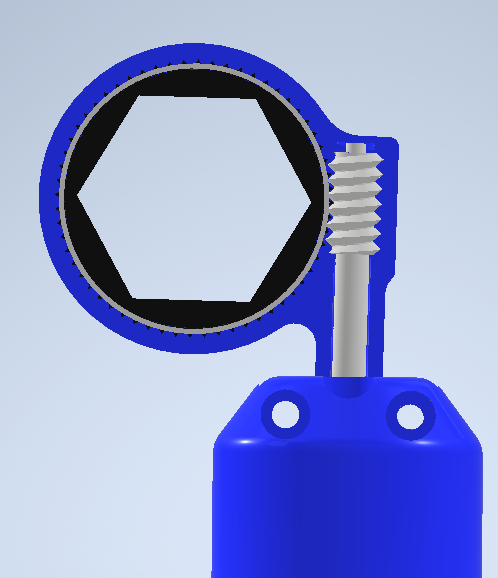
After soldering electronics together and assembling the body (and some percussive maintenance), the wrench worked great. After just a few adjustments, it was ready for testing.
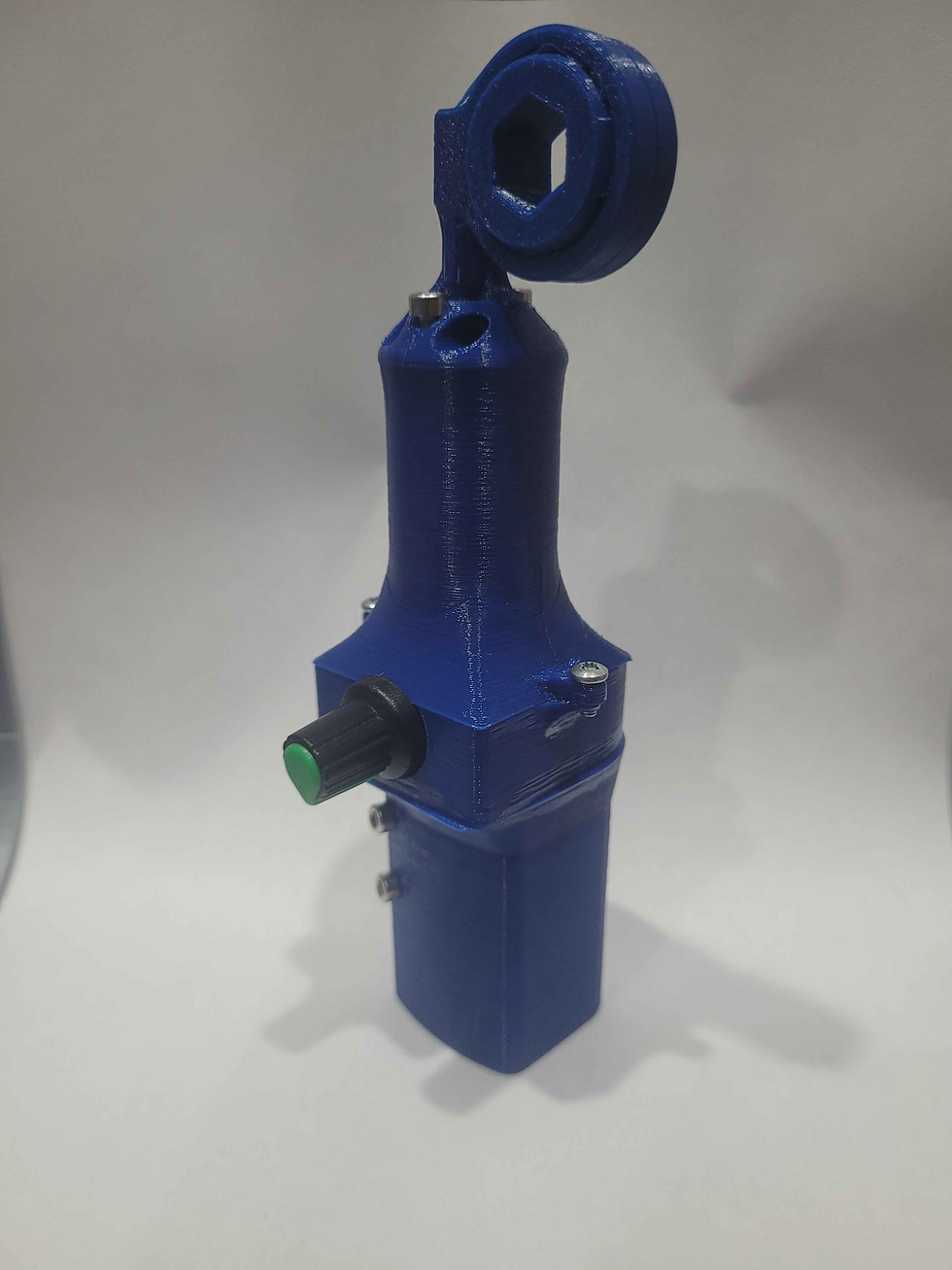
We ran tests on comfort, usability in small spaces, versatility, and compliance with OSHA regulations. All of which the wrench passed, though our sample size for the comfort test was limited due to upcoming deadlines. Our design could fit in half the space as an off-the-shelf compact power tool and was much safer.
Our final presentation went quite well and the judges were very impressed. While I was busy with the FRC season, my teammates brought the wrench to SkillsUSA where they won gold at the State level and ranked 4th at Nationals!
While the prototype was successful, there are a few things we would address in future iterations. First of all we'd improve the gears by printing them from PET-CF to improve their rigidity, design a more rigid structure to hold the worm gear in place, use magnets for the inserts (as opposed to the snap in ones we used originally, redesign the handle to have a fully ergonomic grip and have proper thermal exhaust for the electronics, and use a different controller besides the knob as it requires 2 hands to operate. I hope to work on some of these over break in the next year.
Overall, this was a great project and taught me a lot about product design, and electronics integration. These will be very useful throughout my college and career life.


