Northop Grumman HIP
- Sep 21, 2025
- 4 min read
Updated: Sep 23, 2025
I am lucky enough to live very close to Northrop Grumman's Sykesville site. This presented me with the amazing opportunity to be a part of the High School Involvement Program (HIP). Each year, my high school (Liberty) and our neighbor (Century) each pick two Juniors to join. I was lucky enough to be selected along with a friend of mine, and our later valedictorian, Micah Cooney.
The program was set up in two phases. The 1st year would be webinars and small assignments, teaching us how large tech companies like NG function and the history behind them. Most of these were corporate presentations, showing us why we should work for NG after High School. But every so often they would invite a distinguished guest speaker. The most memorable of which was Dr. John Arenberg, who is now the Chief Missions Architect for Science, Robotics, Space missions. While that's a very impressive title, what all made us pay attention was his role as a Chief Engineer on JWST. His long history of working on space telescopes, including Webb and Chandra, gave him a very unique story. His story further encouraged me to pursue a career in the space sector, either at NASA or commercial.
The second year is a project mentored by NG engineers (big thanks to Tom Eakins, Mark Ingle, Jacob Lettiere, Sterling Mead, and Andre Faubert). This year, me and Micah teamed up with Century's students, Luz Letona and Colin Grimsley. Together we took on the NELL design challenge. Our mission was to launch a water powered rocket to exactly 41ft, and measure that altitude with 2 independent systems. This was inspired by Goddard's first liquid powered rocket that also reached 41ft in altitude and was named NELL.
The first step was of course coming up with a team name, cause that's definitely the most important part. We decided on High Tide, inspired by the water rocket itself (and one of my favorite FRC teams).

Next came breaking the challenge down and assigning duties. I was chosen to be the hardware design lead because of my lengthy experience in CAD and project development. This entailed designing the overall rocket, selecting hardware that would integrate well into the system, and 3D printing the custom components.
After analyzing the challenge, we knew what subsystems we would require. A rocket body (project manual specified COTS), payload accommodation housing, and 2 measurement systems. A recovery system was deemed optional but desired as it wasn't specified in the manual but would be helpful in preventing breakages.
We prioritized the sensor and rocket body selections as those would be the COTS components, and we could mold the housing around them. The rocket body and launch system was an easy choice as there aren't many good quality COTS options. We quickly chose the Strato Launcher Ultimate launch system, which uses a 2-liter bottle to contain the pressure. For the body, we chose a Starry bottle for the near perfectly cylindrical shape and the natural theming.

The altitude measurement was much trickier of a selection. We thought of many different options like altimeters, drones that would hover at 41 ft, cameras running TensorFlow, a laser range finder, or even analog measurements using rulers and a protractor (uses trig to compute the similar triangle). After careful deliberation and decision matrices, we chose the altimeter and a laser range finder + gyroscope system as our 2 methods. The altimeter was a COTS option from Jolly Logic that is often used in model rocketry, we chose this because it was the simplest to execute and should be very precise. The laser range finder and gyro were chosen as it'd be a great learning opportunity in using electronic systems and would be a great challenge. To power and control the laser rage finder, we used a portable battery pack and a RPi Zero W.

Now that we knew what we needed to do, now came integrating them into one system. We dubbed this the "payload accommodation system" and this would house the electronics throughout the launch and flight. This had to be protective enough to prevent the electronics from being damaged, while being light and aerodynamic enough to not impede stable flight. We also decided to make this payload separate from the rocket body, as it would be more akin to a true satellite delivery mission. For this separation mechanism we had 2 options, both of which are passive as to avoid further complexity. Either a nose cone with "rails", to slide off the sides of the body, or an "offset ring", that would go around the body. After accounting for weight and complexity, we chose the offset ring as it would be the simplest to integrate into the nose. This subsystem would be 3D printed out of PETG with plans to later switch to either PETG-CF or TPU.
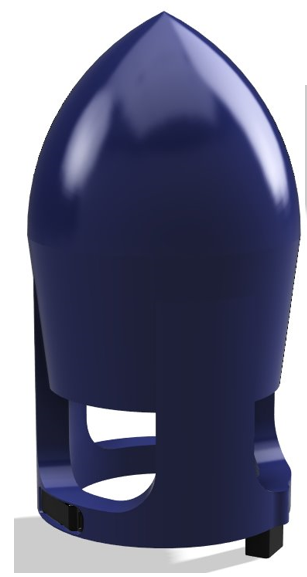
Now that it was designed, I printed off the parts and soldered the electronics. The other members took care of the most of the assembly as I was at a robotics competition that weekend.

We then developed a test procedure and ran tests to determine the effect of air pressure and volume of water on the altitude reached. As well as comparing the methods of measurement to each other and the simulation data in each trial.

Soon, in one of these tests, the parachute did not deploy properly and resulted in a breakage in the nose cone. While this was unfortunate, it was expected as we were working with simple PETG. However, this gave us the opportunity to redesign the rocket for the final presentation. This new design was much smaller and more compact. We decided it wasn't worth it to print in TPU or PETG-CF as we didn't plan to launch it, but that would be greatly preferred if we continued with this project.

Overall, this was an amazing experience to work with in field engineers and learn from them. This also gave me fantastic contacts in the industry to ask for advice as I continue my own career. This was a really fun team to be a part of, and I had a great time working on this project with them.
Thanks for reading,
Austin
P.S. Never forget to reach for the moon


