Testudog
- Aug 15
- 4 min read

Testudog is the quadruped part of one of UMD's flagship clubs, Robotics @ Maryland (R@M). Basically, we make a fully custom-built robot dog to compete at IEEE's ICRA challenge, where teams from all over the world compete in obstacle course-style challenges. While most of the dogs there are bought from Boston Dynamics or Unitree, we are the 4th university in the world to build and compete with a fully custom dog. The club was born during covid through a graduate student's project. Then after he graduated it became a full team of about 20 people. And finally, after all that time, 2026 was the first year the club has qualified for ICRA.
While this post is gonna start in Fall 2025 as that's when I joined, I'll give you a quick summary of the state of the dog when I joined the team. Basically, the first version of the dog a few years ago had entirely 3D-printed legs and was very unoptimized. The legs would break anytime the motors reached stall, the software side was really bad, and the dog has barely been able to stand. Then in spring of 2025 the team made the first version of the current aluminum legs. The body structure was 4 aluminum rods that stretched across the full length of the dog, with 2 aluminum threaded rods mounting to the leg motor mount plates on either side of the dog. The battery had to be left out of the chassis, as it didn't have the structural support or mounting for it. Additionally, the supposed design for the new body, after about 30 seconds of review by me and another freshman, was determined would banana if literally any load was put on it.
And so here we are; I joined a team with a nonfunctioning bot, a failed plan to build a new body, and a lot of new skilled members that thought robot dogs were cool enough to put our time into making a good one.
As with any larger engineering club, there's a distinct difference in technical experience. Because of my time in FRC, I was quickly put on more complicated components. In my first week on the team I made an adjustable camera mount so software could determine the optimal angle.
Soon after that, I was put on the small team of people working on fixing the design for the new body and researching better layouts for the new dog.
So to give you a run down of how the dog functions. Basically each leg has 3 motors. 2 of which act as a hip, moving the thigh in 2 axes. The third is belted down to the knee joint to move the shin. These 3 movements together, combined with all 4 legs, makes the dog able to stabilize itself and traverse by walking. On the software side, we now use an AI optimization algorithm and a simulation package to test the movements of the dog and prepare it for real obstacles.
The first new design utilized box tube and 3d-printed struts to build an extremely rigid body.

This was quickly determined to be far too heavy, but we learned a lot from the design process of it. We also determined that mounting the main leg motors inside of the body would be a far more efficient design than our current layout.
Due to lack of progress on making the current dog work, as well a lapse in funding, we decided to table making a new dog in favor of improving the current one. We were still researching better designs for next year, but they would have to wait to be realized.
My efforts on the current dog were mainly for electronics mounting/layout and optimizing the movement of the dog overall. Additionally I was the main 3D printing person that ran the majority of the parts on the dog.
First on the list was making a mount for the battery and laying out space for other more sensitive electronics. Leading to this design where the battery hangs on the underside of the robot with plenty of room for electronics to be mounted inside the main body. We ideally would then add a g10 sheet above the battery to thermally isolate the sensitive electronics (eg. the Jetson Orin) from heat-producing ones like power and the battery.

I also worked on several individual mounts for the many boards that would be used.
Soon after this it was time to present our findings at the R@M design review presentation in front of about 50-75 people from all 3 clubs plus some of our faculty/alumni advisors. I was luckily chosen to be one of the presenters for the mechanical team.
After the fall semester, I was promoted to being a design reviewer for mechanical projects. Basically meaning I could check off designs for manufacturing, as well as give advice for fixing them. I was also made the unofficial special projects guy, and this is when my work became many small complicated and higher level designs, rather than smaller simple parts.
The first of these projects was an attempt at replacing the built-in internal gearbox of the Cubemars AK60 motors with a custom 2-stage cycloidal that would greatly increase the amount of torque our robot produces.

After many iterations of decreasing backlash and repackaging, the 3DP prototype was done. At just 24mm outer diameter, this is somehow not the smallest cycloidal I made my freshman year (see the Jeff post for that one).

Unfortunately we ruled this was too much of a risk as the parts were all extremely small and at risk of breaking, even if we made the metal version.
Additionally I helped review the upgraded leg design

And had a very large role in research/designs for the new dog body as well as the upgraded currrent dog.
A few quick pictures here from the rest of the semester


And after all that, we arrived to this shockingly ok assembly for the competition, before replacing parts with the ones from the SendCutSend order. I would add a newer picture, but we completely forgot to take one in the rush to get to comp.
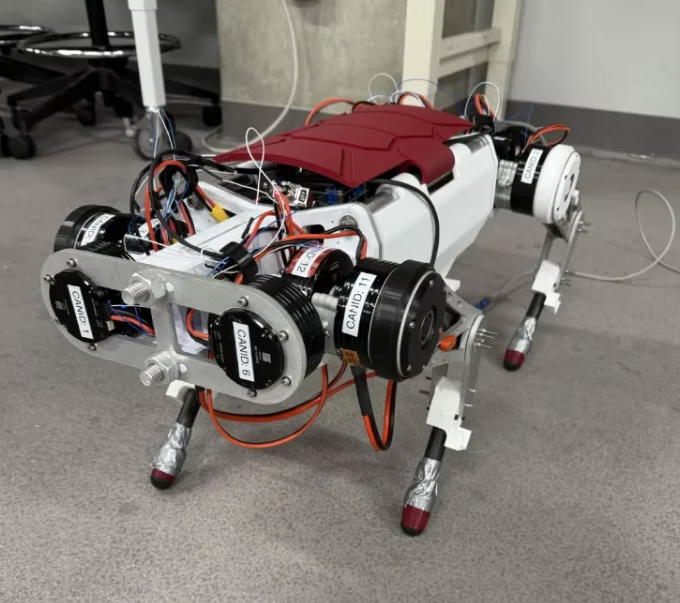
Some of the leads then travelled to Austria for ICRA where this dog competed.


